Language your ethics board can accept.
"Recordings are stored only on the interviewer's device and are never transmitted to a third party." That is how the app works, not a policy promise.
Transcripts ready for coding.
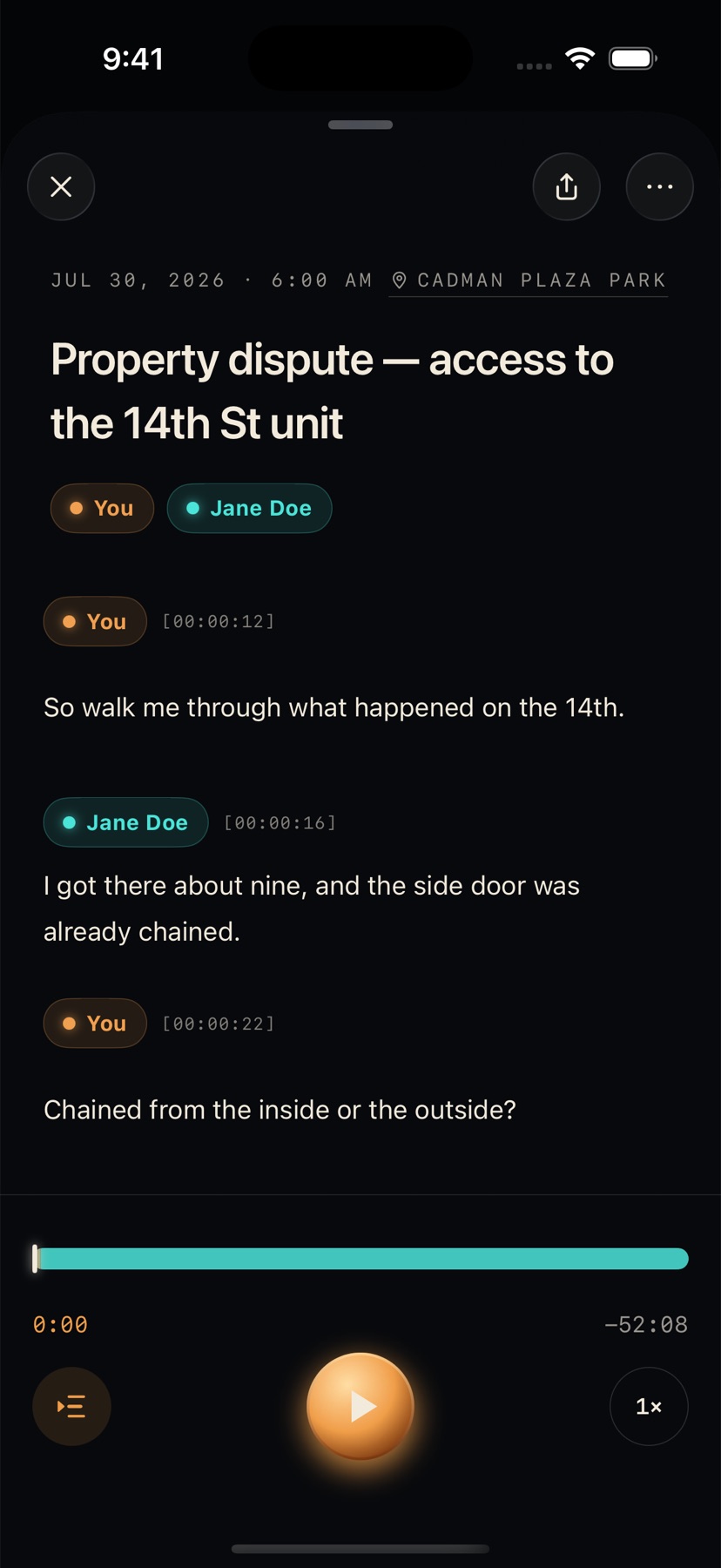
Speaker-labeled, timestamped, exported as Word, Markdown or plain text. Open them in whatever you code in.
Batch the backlog.
Import existing recordings, even long ones, and let the phone work through them. Video files are handled too.
How it works
Record the session.
Or import the audio from a recorder you already use.
Name the participant once.
Every turn of that voice is labeled. The voiceprint stays on the phone and can be deleted when the study closes.
Export and code.
One file per interview, in the format your analysis tool reads.
Questions
Does the app send anything anywhere?
Only anonymous usage counts, such as how long transcription took, to an analytics service. Never audio, transcript text, names or titles. The privacy policy lists exactly what is sent.
How do I delete a participant's data?
Delete the interview and, if you named them, delete the remembered voice from the app's settings. Both are removed from the phone.
Can I transcribe recordings made on another device?
Yes. Share any audio or video file to Interview and it is transcribed on the phone.
What does it cost?
Free download with two full interviews included, then a one-time $19.99 unlock. No subscription, so it fits a one-line budget.
Qualitative research · User research · Oral history